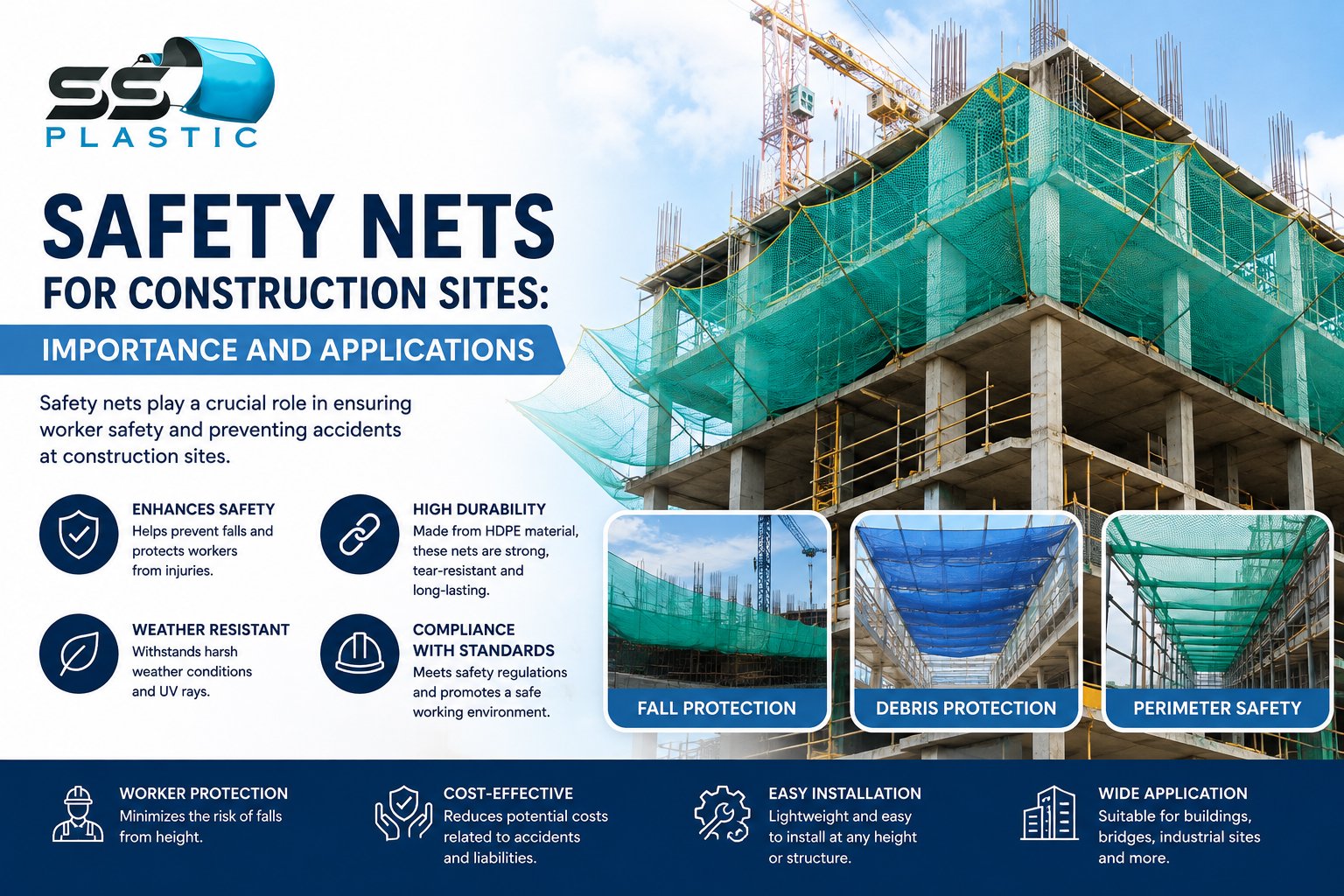
Safety Nets are an important covering and protection solution for construction environments where work is carried out at different heights and across multiple working zones. Construction sites can involve elevated activities, open areas, building structures, scaffolding, and material movement, making suitable protective arrangements an important part of site planning. Safety nets can be incorporated into a broader construction-site safety system to provide additional protection in appropriate applications. They are designed to create a protective netting barrier around selected areas and can help support more organized and controlled working environments.
S. S. PLASTICS offers safety nets in different configurations to meet the varied requirements of construction projects. The product range includes 2-layer and 3-layer safety net options, allowing customers to select a suitable configuration according to their application and project conditions. Different construction projects may have different site layouts, working heights, coverage requirements, and installation conditions, so selecting the appropriate netting solution is important. Customers can consider the required area, application, net configuration, and installation environment before choosing a product.
Construction companies can use safety nets around suitable working areas as part of their overall site protection arrangements. They may also be useful for creating additional protective barriers around selected construction zones and for helping manage areas where there is a potential risk of falling debris. The exact use of a safety net should always be determined according to the specific site conditions, project requirements, and applicable safety practices. A properly selected and correctly positioned net can contribute to better organization of construction work zones and provide an additional layer of protection where appropriate.
Proper installation is an important consideration when using safety nets at construction sites. The net should be installed according to the requirements of the specific application and the conditions of the working area. Correct positioning, secure fastening, and suitable support points can help ensure that the net remains properly placed during use. Construction managers and site teams should assess the installation environment carefully before fixing the net. The size and configuration of the net should also be considered to ensure that the selected product provides suitable coverage for the intended area.
Construction projects can vary significantly in size, design, height, and working conditions. A small residential construction project may have different netting requirements compared with a large commercial or industrial development. For larger construction sites, multiple netting solutions may be required to cover different work zones. Selecting a product according to the size and requirements of each area can help create a more organized approach to site protection. Safety nets can therefore be a useful component of construction-site planning when selected and installed appropriately.
Safety nets can be useful for residential construction projects as well as commercial and industrial construction applications. Builders and contractors can consider suitable netting solutions for different types of construction work where additional protective arrangements are required. They can be used around selected working areas, building structures, and other suitable zones depending on the project requirements. Their flexible application makes safety nets a practical option for construction companies that need adaptable netting products for different site layouts.
Regular inspection is also an important part of maintaining safety-net arrangements during continued use. Users should periodically check the net for visible damage, excessive wear, loose sections, or other conditions that may affect its intended application. Any damaged or unsuitable net should be addressed before continued use. Routine inspection can help construction teams identify potential issues at an early stage and maintain better control over their site protection arrangements. Proper handling and storage are also important when safety nets are not being used.
When stored, safety nets should be kept in a suitable location and protected from unnecessary damage, excessive exposure, or improper handling. Proper storage can help maintain the condition of unused netting and make it easier to prepare for future projects. Construction businesses that use safety nets regularly can maintain suitable storage practices to help keep their products organized and ready for use. Along with proper installation and routine inspection, appropriate storage can contribute to the practical usability of construction netting.
S. S. PLASTICS focuses on providing practical and cost-effective plastic protection products for different construction and industrial requirements. Safety nets are one of the construction-related products available from the company, along with HDPE Tarpaulin and other covering solutions. Customers can select suitable products according to the specific requirements of their projects. Combining different covering and netting products may help construction companies address various site requirements, from material covering and storage protection to suitable protective netting applications.
Before purchasing a safety net, construction managers and contractors should carefully consider the intended application, required coverage, installation environment, net configuration, and project conditions. Choosing a product based on the actual requirements of the site can help improve practical use and installation. The size of the area, location of the net, method of fastening, and surrounding working conditions should all be evaluated before installation. Proper planning can help ensure that the selected netting solution is suitable for the intended construction application.
Secure installation and proper fastening are essential considerations for the practical use of safety nets. The net should be positioned correctly and attached using suitable methods according to the site requirements. Construction teams should ensure that the installation is carried out carefully and that the net remains appropriately secured during its intended use. Regular checks can also help confirm that the net remains in suitable condition throughout the project. These practices can support a more organized approach to construction-site protection.
A reliable safety net can become a useful component of construction-site planning by providing additional protective coverage in suitable applications. It can help construction companies create more controlled work zones while supporting their broader site safety arrangements. Whether the project involves residential construction, commercial development, industrial construction, or a larger infrastructure-related site, the appropriate netting solution can be selected according to the specific requirements.
S. S. PLASTICS provides safety nets designed for varied construction requirements, including different configurations such as 2-layer and 3-layer options. Customers can evaluate their project needs and select a suitable netting solution based on the application, coverage area, and installation conditions. With safety nets, HDPE Tarpaulin, and other plastic protection products, S. S. PLASTICS offers practical solutions for customers looking to manage different construction-site covering and protection requirements. Customers can contact the company to discuss their project requirements and identify a suitable safety-netting solution for their application.